

Virginia Senate and House pass bills to legalize casino gambling in five cities
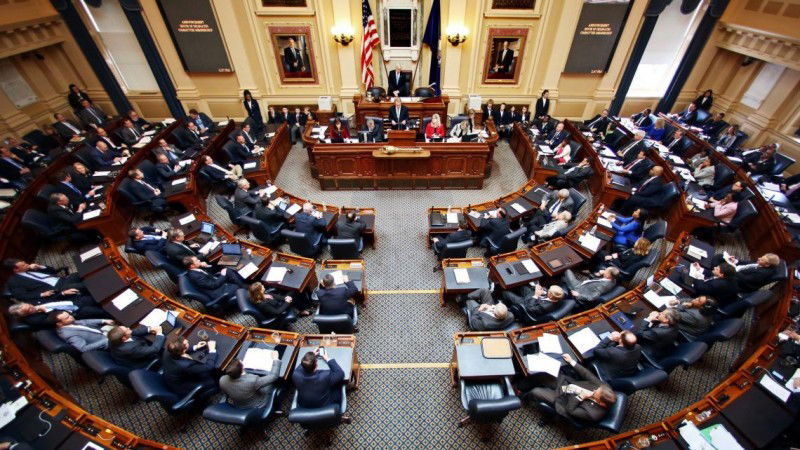
Both the Virginia House and Senate approved legislation Tuesday to allow casinos by referendum in five cities.
The Virginia House of Delegates passed House Bill 4 with a 61-33 vote earlier that day, a bill that would legalize casino gambling in some parts of the Commonwealth, pending voter referendums in each of the cities. On Tuesday night, the Senate approved similar legislation — Senate Bill 36 — by a margin of 29-11.
Each bill will now shift to the other chamber for review and potential approval, starting Wednesday, Washington County News reports. Both bills are similar, the major difference being the amount of tax revenue that will go back to the state and local community. A committee of conference may be used to decide a compromise. Sports betting is also part of the casino bill. The session is scheduled to adjourn March 7.
On Tuesday the Senate also joined the House in banning “skill” or “gray” machines, which critics argued would take away millions in profits from the Virginia Lottery.
“I appreciate the strong support that HB 4 and SB 36 have received as they have advanced through each chamber,” Jim McGlothlin, chairman and CEO of The United Co. and one of two primary developers of the proposed Hard Rock Bristol Resort and Casino, said in a written statement. “Legislators clearly recognize that Bristol needs a long-term, sustainable solution for our local economy. We still have a long way to go in this legislative session before the bills are reconciled and approved by the General Assembly and signed into law by the governor, but I am very encouraged by the progress we are making.”
“Today, in passing HB 4, the House of Delegates embraced our goal to bring a significant economic development project to Bristol,” said Delegate Terry Kilgore (R-1, Gate City). “I look forward to working with my colleagues in the House and Senate to pass this bill. Southwest Virginia needs the new jobs and additional tax revenue that will be generated by the Bristol Resort and Casino as Bristol Hard Rock.”
Delegate and Bill Sponsor Barry Knight (R-Virginia Beach) highlighted the benefits of the legislation. "It's got five locations, which are Bristol, Danville, Norfolk, Portsmouth and Richmond," he said. "These are economically depressed areas that could use the jobs in the state of Virginia."
Localities will be able to choose their local development partner with the help of an expanded Virginia Lottery Board, which will oversee the business. The locality has to follow the criteria outlined in the bill for a development partner and the state has to approve their choice before a referendum is held. In addition, an approved amendment grants the Pamunkey Indian Tribe “preferred” status in its efforts to build casinos in Richmond and Norfolk. The tribe previously announced agreements to acquire land in both cities and establish casinos in each.
The bill has provisions for problem gambling, including a prevention/treatment fund and a voluntary exclusion program. Under this program, if a person puts there name on a list, they will not be able to enter a casino.
The prospect of casino gambling in locations across the state has drawn protests from religious groups and other opponents, but no one spoke against the legislation on the floor of the House. "I believe that this measure very much accomplishes the overall objective of bringing a lot of people to the table and looking at it from a global perspective," said Delegate Joe Lindsey (D-Norfolk). "And for that reason, I support the measure."
The Virginia Lottery would regulate the casinos. The legislation lays out the tax structure. Both bills also include provisions to address potential impacts on the incumbent Colonial Downs Group and its chain of Rosie’s Gaming Emporiums. A state study found the group would be negatively impacted financially by casinos operating in Virginia.
The legislation would also encourage minority hiring, require a living wage and fund programs for problem gamblers. Also, local residents would have a say. "What's most important is that in this bill there is a referendum," said Delegate Don Scott (D-Portsmouth). "Every community will have the final say on what is in their community, and for that reason I would ask that we engross the bill and move it forward."
A similar bill is moving forward in the State Senate, SB 36, so there should be a final vote in both chambers, before Tuesday's deadline for each house to complete work on its own legislation.
The greatest difference between the two versions is with the proposed tax rates, according to the Bristol Herald Courier. The House version features a two-tier system of taxation of gaming revenues, based on the documented financial investment in a casino. A casino built for between $250 million — the minimum required — and less than $350 million would have its first $150 million in annual gaming revenues taxed at 15%, its next $150 million taxed at 20% and revenues above $300 million taxed at 28%. A casino valued at $350 million or more would have its first $200 million in annual gaming revenues taxed at 15%, its second $200 million taxed at 20% and revenues above $400 million taxed at 28%, Knight told House members.
The proposed Bristol Hard Rock Resort and Casino and the Pamunkey Norfolk casino are projected to cost $400 million each, and the Pamunkey casino proposed for Richmond is expected to cost $350 million. The Rush Street Gaming casino planned for Portsmouth doesn’t yet have a cost estimate, and officials in Danville haven’t selected a potential casino project or operator.
Under the House bill, a locality would receive between 5% and 7% of taxes on gaming. Those same tax rates were included in a previous version of the Senate bill but raised during last Thursday’s Finance and Appropriations Committee. The Senate bill now proposes taxing the first $150 million of annual revenues at 27%, the next $150 million at 31%, and all annual revenues above $300 million would be taxed at 40%. The Senate bill makes no distinction based on the value of the casino.
The Senate version also prescribes that localities would receive between 9% and 11%. The House version proposes charging a $5 million one-time fee for a casino operator’s license while the Senate bill would charge $15 million for that license.
The Eastern Band of Cherokee Indians have proposed a casino project for the Pinnacle just outside of the Bristol city limits, but the casino bill does not make Washington County, Virginia eligible for a casino. Before Tuesday final vote, Richard Sneed, Principal Chief of the Eastern Band of Cherokee Indians (EBCI), said he believes lawmakers should slow down the legislative process, News Channel Eleven reports. “I’m always nervous in anything that governments are doing, when it’s like, ‘We have to do it right now.’ Usually, the results are not optimum,” said Sneed.
Sneed and the EBCI have a competing casino plan in Washington County, Virginia. Their plan is in partnership with Pinnacle developer Steve Johnson. Sneed said he believes the tribe’s casino plans on the Virginia side of the Pinnacle have huge potential. But a competitive bidding amendment that could allow a Cherokee casino at the Pinnacle is not on the drafted bill in Richmond, which shuts out the possibility of a Washington County-based casino, one Johnson said would anchor a planned water park, golf venue, amphitheater, and more.
Wisconsin governor begins tribal talks to advance online sports betting rollout

Liga MX names Polymarket its exclusive prediction market partner for the US

Hard Rock Bet rolls out Matthew Broderick-led campaign for sportsbook and casino


Flutter to delist from London on 3rd August as NYSE remains main trading venue

Win Systems appoints Ana Aniceto to lead Country Manager & Sales in Peru

WagerWire receives Gibraltar approval in principle for prediction markets push

EGT Digital partners with CSKA Sofia through new sponsorship deal

Ready Play Gaming content set to go live via Nirmata Play


Pidiots and the future of slot engagement: Why Slotmatic is building the intelligence layer behind the next generation of slots


Boomerang Partners launches second stage of Golden Boomerang Awards 2026

Day 1 of SBC Summit Americas spotlights prediction markets, AI and industry challenges