

Caesars Entertainment reports financial results for Q1 2018
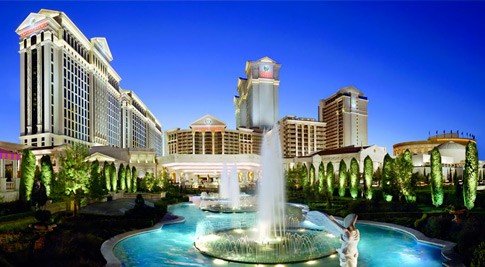
Caesars Entertainment Corporation today reported first quarter of 2018 results as summarized in the discussion below, which highlights certain GAAP and non-GAAP financial measures on a consolidated basis.
First Quarter Highlights
First quarter net revenue increased $1 billion, from $966 million to $1.97 billion, due to the inclusion of the results of CEOC, LLC, which emerged from bankruptcy in the fourth quarter of 2017.
Net loss improved $473 million, from $507 million to $34 million, due to restructuring charges in the prior year.
Adjusted EBITDAR improved $243 million, from $275 million to $518 million, due to the inclusion of the results of CEOC.
Same-Store Highlights
Same-store net revenues declined 2.0% or $40 million, from $2.01 billion to $1.97 billion.
Same-store adjusted EBITDAR decreased 3.4% or $18 million to $518 million, driven primarily by unfavorable year-over-year hold and weather-related property closures.
Las Vegas RevPAR decreased $2 to $142. Las Vegas Cash ADR decreased $1 to $173.
CEC executed another $1 billion interest rate swap, increasing its fixed debt percentage to 47% excluding the convertible debt.
"Our first quarter results exceeded our expectations, despite unfavorable year-over-year hold, several weather-related property closures and a shift in the Las Vegas convention calendar compared to the first quarter of last year," said Mark Frissora, President, and Chief Executive Officer. "Strength in our core business including slot win growth and increases in operating efficiency mostly offset headwinds. Meanwhile, we now have the flexibility to return capital to shareholders under the new share repurchase authorization enabled by our healthy core business and strong projected future free cash flows."
"Gaming and hotel results proved to be stable in April and economic indicators are favorable," said Eric Hession, Executive Vice President, and Chief Financial Officer. "We remain optimistic in our earnings outlook for the full year."
Summary Financial Data
Note that certain additional non-GAAP financial measures have been added to highlight the results of the Company including CEOC. Due to the timing of CEOC's emergence, Caesars results do not include CEOC in the prior year. "Same-Store" results reported herein include CEOC as if its results were consolidated during all periods, but remove the unconsolidated Horseshoe Baltimore property from all periods presented. See the tables at the end of this press release for the reconciliation of non-GAAP to GAAP presentations. GAAP and same-store results include Caesars Acquisition Company ("CAC") for all periods presented because CEC's merger with CAC was accounted for as a reorganization of entities under common control. For same-store result reconciliations by region, see the historical information supplement in the Investor Relations section of www.caesars.com.
We adopted ASC 606: Revenue from Contracts with Customers, effective January 1, 2018, using the full retrospective method, which requires the Company to recast each prior reporting period presented consistent with the new standard.
Share Repurchase Program
CEC's Board of Directors has approved the repurchase of up to $500 million of CEC's common stock. Repurchases may be made at the Company's discretion from time to time on the open market or in privately negotiated transactions. The repurchase program has no time limit, does not obligate the Company to make any repurchases and may be suspended for periods or discontinued at any time. Any shares acquired will be available for general corporate purposes. CEC intends to finance the share repurchase program using cash from operations.
Financial Results
We view each casino property as an operating segment and aggregate such casino properties into three regionally-focused reportable segments: (i) Las Vegas, (ii) Other U.S. and (iii) All Other, which is consistent with how we manage the business. The results of our reportable segments presented below are consistent with the way management assesses these results and allocates resources, which is a consolidated view that adjusts for the effect of certain transactions between reportable segments within Caesars. "All Other" includes managed, international and other properties as well as parent, consolidating, and other adjustments to reconcile to consolidated Caesars results.
In the U.S. GAAP consolidation tables below, the inclusion of CEOC's results is the primary driver of year-over-year fluctuation. In accordance with U.S. GAAP, the results of CEOC and certain of its U.S. subsidiaries were not consolidated with Caesars from January 15, 2015 until October 6, 2017. Additionally, Caesars unconsolidated the results of its Horseshoe Baltimore property in the third quarter of 2017.
Same-store columns below include CEOC and certain of its U.S. subsidiaries as if they consolidated in all periods, and exclude the results of the Horseshoe Baltimore property in all periods. GAAP and same-store results include CAC for all periods presented because the merger was accounted for as a combination of companies under common control. The intent of the same-store information is to illustrate certain comparable results based on the current consolidation structure.
The inclusion of CEOC's results increased CEC net revenues by $1 billion. The only material change in Las Vegas is the inclusion of Caesars Palace in the current year. In the Other U.S. and All Other regions, the year-over-year comparison is not meaningful due to the magnitude of consolidating CEOC's regional, managed, and international portfolio.
Same-store revenues declined 2.6% in Las Vegas, primarily attributable to $19 million of year-over-year unfavorable hold. Additionally, a major convention that took place in the prior year weighed on food and beverage revenue, RevPAR, and ADR. Same-store revenues fell 1.2% in the Other U.S. region. The declines were attributed to weather-related property closures. Substantial reductions in gaming-related marketing offers, treated as contra-gaming revenue in accordance with U.S. GAAP, as well as $5 million of favorable hold also helped offset the declines.
The inclusion of CEOC's results in the current year drives changes in reported income from operations. Increased depreciation expense related to the fair value adjustment to failed sale-leaseback assets recorded on the balance sheet at emergence in 2017. Other operating costs increased $67 million due to exit fees related to NV Energy utility contracts and lease termination costs at Planet Hollywood. Due to the adjustments at emergence, the year-over-year comparability of same-store income from operations is not meaningful.
Net loss improved $473 million over the prior year, primarily due to restructuring-related expenses in the prior year. Same-store net income is not a meaningful comparison. Restructuring charges in the prior year will not recur. Additionally, CEOC was not accruing interest expense on its finance obligation in the prior year. The Company refinanced its conventional debt throughout 2017, resulting in substantial savings on debt-related interest expense.
Reported adjusted EBITDAR improved $243 million due to the consolidation of CEOC's results in the current year.
Same-store adjusted EBITDAR declined $18 million from the prior year. In Las Vegas, $18 million of unfavorable hold compared to the prior year negatively impacted results. The unfavorable hold related to a high volume of baccarat play during the Chinese New Year at Caesars Palace. Weather-related closures and disruptions in the Other U.S. region impacted results by approximately $15 million. Sharp reductions in gaming-related marketing offers in the Other U.S. region offset the weather, driving a 7.5% improvement in property EBITDAR against the prior year. A $4 million year-over-year hold headwind at our U.K. properties and increased corporate costs drove the decline in the All Other region.
World Cup weighs on Macau casino revenue as June gaming pace slows, Citigroup says

Spindex launches platform aggregating live crypto casino data across games and operators

Bally's Chicago gets one-year extension to complete permanent casino project


Soft2Bet wins SBC award for Industry Innovation of the Year in North America
BetMGM's Brazilian venture moves to acquire Bingão do Brasil in market expansion push

California's Jamul Casino Resort brings in Marcus Lucero as Vice President of Casino Operations

Flutter to delist from London on 3rd August as NYSE remains main trading venue


N1 Partners named finalist in three categories at G Gate Awards 2026

BGaming sets July date for second TRUE WAYS online conference

Day 1 of SBC Summit Americas spotlights prediction markets, AI and industry challenges


