

Federal government lawyers ask appeals court to reinstate Florida's gambling compact with the Seminoles
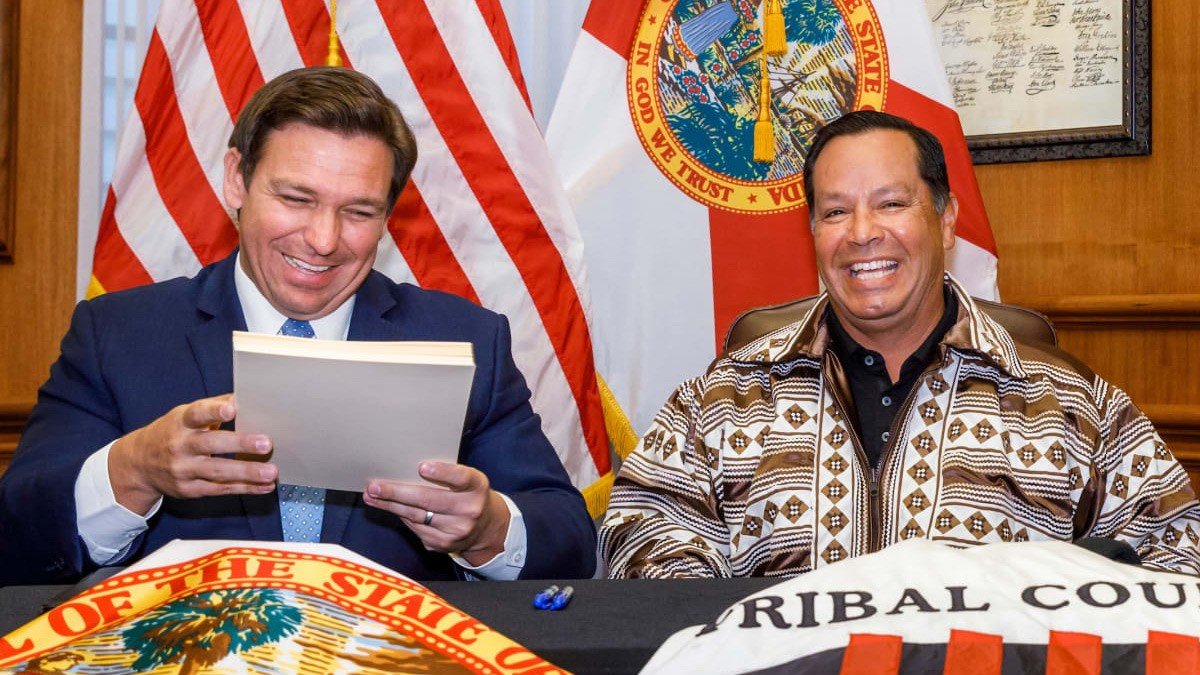
Lawyers for the federal government asked a federal appeals court on Wednesday to reverse the ruling that invalidated Florida’s updated gambling compact with the Seminole Tribe. The deal, signed last year by Gov. Ron DeSantis and the Seminoles, attempted to give the tribe a monopoly over sports betting in the Sunshine State.
A three-judge panel on the U.S. Court of Appeals for the District of Columbia Circuit heard Wednesday arguments from the U.S. Department of Interior, the State of Florida, the Seminole Tribe and the plaintiffs: West Flagler Associates, which owns Magic City Casino and Bonita Springs Poker Room.
At issue is whether Secretary of Interior Deb Haaland, whose agency oversees tribal gambling, acted within her authority under the Indian Gaming Regulatory Act when she took no action and let the gambling agreement between the state and the tribe take effect, reports Tampa Bay Times.
Under the 30-year agreement, which was approved by the Florida Legislature, the Seminoles agreed to pay the state at least $2.5 billion over the first five years of the deal. In exchange, the tribe would be granted sole control over sports betting in Florida, in addition to being allowed to add roulette and craps to the tribe’s casino operations.
In order to get around a constitutional amendment that prohibits the expansion of gambling outside of tribal land without voter approval, the compact called for the operation of a so-called “hub-and-spoke model” for sports betting. The process allowed online sports wagers throughout the state as long as these were processed through servers on tribal lands.

However, this model soon proved to be controversial. Opponents argued the compact circumvented the state law prohibiting the expansion of gambling without voter approval. Among those against the agreement is West Flagler Associates, owners of Magic City Casino and Bonita Springs Poker Room, which filed a lawsuit against Haaland.
In her original ruling, handed out in November 2021, Judge Dabney L. Friedrich of the U.S. District Court in the District of Columbia sided with the plaintiffs and invalidated the deal. She concluded that the expansion violated federal Indian gaming law, deeming the hub-and-spoke model “a fiction,” and said Haaland erred in allowing the deal to go forward.
During Wednesday’s two-hour hearing, Rachel Heron, attorney for the Department of Interior, defended Haaland’s decision and argued that the secretary “acted lawfully” and that the district court’s conclusion was based “on an error of federal contract law interpretation,” as reported by Tampa Bay Times.
The attorney argued that while the secretary of the interior has a duty to make sure a compact does not violate federal Indian gaming law, she does not have a duty to make sure that it does not violate state law. She further urged the judges to reinstate the agreement, and allow the tribe to return to collecting bets outside of Indian lands.
For his part, Hamish Hume, of Boies Schiller and Flexner LLP, who represents West Flagler, argued that the agreement with the state cannot legalize gambling activity unless it occurs on tribal land. He suggested that the federal government was trying “to have it both ways,” by asking the court to reverse the lower court ruling “while they say in their legal briefs that (the IGRA) cannot authorize gambling off Indian lands.”
Throughout the legal battle, West Flagler Associates has claimed it would be economically harmed by the competition from the sports betting operation. Four days after the Seminole Tribe began a soft launch of its online sports betting app, West Flagler claims it saw a 35% drop in daily wagers.
Kentucky Attorney General sues Kalshi, Polymarket, and VGW over alleged illegal gambling

Michigan judge rules Polymarket sports contracts fall outside CFTC authority

California and Minnesota AGs push back on CFTC over prediction markets


Entain reportedly considering sale option for CEE Venture as UK gambling tax costs mount

SafeCasino named Best New Casino at AskGamblers Awards 2026

Fast Track partners with Meridianbet to support customer engagement across 18 markets

Digitain wins Platform Provider of the Year at SBC Awards Americas 2026

Real-time rewards: Why decision quality matters more than speed


Ready Play Gaming content set to go live via Nirmata Play


Zitro draws record operator attendance at fifth Zitro Experience Peru event

Peru Gaming Show wraps up with criticism of consumption tax and discussion of World Cup betting activity

DELULU Gaming names SOFTSWISS strategic technology partner for London soft launch dinner


