

Kansas full Senate passes online and in person sports betting bill
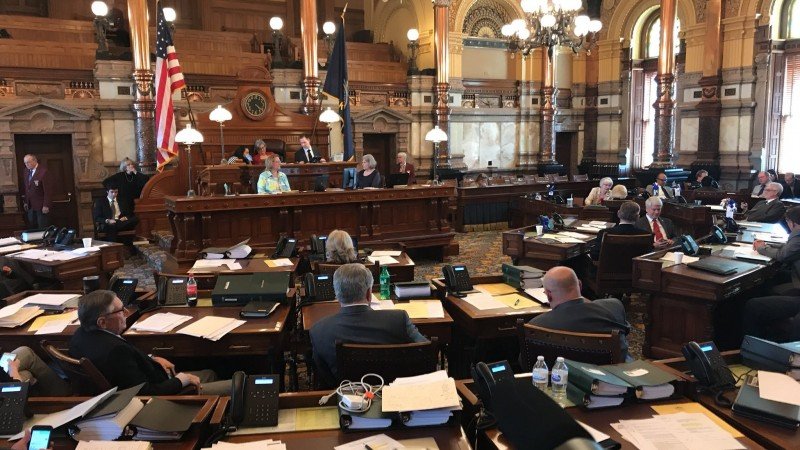
After months of talking about the issue, the full Kansas Senate debated sports betting on Wednesday for the first time and passed the bill passed 23-15.
The Senate plan authorizes casino managers to expand their offerings to include sports wagering. The state would get 7.5% of the profits for bets placed inside the casinos, and 10% of the profits for bets placed online. The casinos would negotiate deals with digital platform providers. Tribal casinos could apply to allow sports betting if it passes.
Adults could place bets on professional and college athletics through online platforms and in person at the four state-run casinos. Two percent of all revenues would go to the gambling and addictions grant fund. Gambling would be restricted to adults who are at least 21 years old.
Senators went back and forth for nearly six hours about the details of the bill. They talked about where revenue should go, whether horse racing or greyhound racing should be a part of the bill, and how much money should be set aside for gambling addiction, KSNT reports.
The bill now heads to the House and if passed, would head to the governor. A separate plan is working its way through the House.
Sen. Jeff Longbine, a Republican from Emporia, said the legislation represented work that began before the U.S. Supreme Court in 2018 affirmed the right of states to legalize sports wagers. “It certainly has put us in a position where we can establish sports gaming in Kansas and pull wagers from the black market — offshore, unregulated, untaxed market — bringing Kansas under a regulated state market,” Longbine said, according to The Topeka Capital-Journal.
Sen. Tom Holland, a Democrat from Baldwin City, questioned whether the two years of work on the plan included “critical thinking.”
The proposal is expected to unleash up to $600 million in sports bets in the first year, but the state’s cut would be no more than $3 million. Holland said he was afraid the state is “leaving money on the table.” “At the end of the day, this has to be a profitable to the state,” he said.
The four state-owned casinos in Kansas include Hollywood Casino at Kansas Speedway in Kansas City, Kansas Star Casino in Mulvane, Boot Hill Casino in Dodge City and Kansas Crossing Casino and Hotel in Pittsburg.
Some of the state revenue would funnel into the Horse Fair Racing Benefit Fund and to establish a new White Collar Crime Fund for investigations led by the Kansas Attorney General. The chamber adopted a proposal by Senate President Susan Wagle, R-Wichita, to divert 2% of revenue into a state fund for treating gambling addiction. Her amendment also requires the money in that fund to be used as intended. Historically, the money has been raided for other health needs.
Wagle said 54,000 Kansans have a gambling problem, and most of those have other addictions. “If you’re drinking and gambling, you can get in big trouble,” Wagle said. “Our situation here is we’re now going to make this readily available through our new technologies on phones and on computers.”
Holland introduced an amendment to shift profits away from casino operators and into state coffers. Under his proposal, which failed to win support, the Kansas Lottery would have control over online gambling for sports and, potentially, other games.
Senate Minority Leader Anthony Hensley, D-Topeka, said state regulators had little role in crafting the sports wagering plan. “This bill is of the casinos, by the casinos and for the casinos,” Hensley said.
Sen. Rob Olson, R-Olathe, lashed out at Holland for presenting a competing plan. Kansans are tired of lawmakers bickering about how to implement sports gambling, Olson said, and have to go to Iowa to place bets. “We’re never going to get that money back,” Olson said. “We’re going to mess around here until we mess this bill up.”
The chamber shot down Holland’s amendment, and a flurry of other proposals.
Sen. Kevin Braun, R-Kansas City, introduced a plan to bring business back the Woodlands, a horse and dog racetrack in his district that opened in 1989 and filed for bankruptcy in 1996. The possibility to revive the track opened in 2007 with the Kansas Expanded Lottery Act, which allowed the Woodlands to add state-owned slot machines to its complex. The track closed again a year later.
The Woodlands was purchased by Kansas billionaire Phil Ruffin in 2015. If revived, the track would include horse racing, but no greyhound racing. Braun’s amendment would have slashed the state’s cut of profits from slot machines at the Woodlands, which would ignite a court battle with casinos.
Sen. Randall Hardy, R-Salina, wanted to add greyhound racing, which he said “has been given a stigma it does not deserve,” to the scope of legalized gaming in Kansas.
Sen. John Doll, R-Garden City, and Sen. Richard Hilderbrand, R-Galena, called for the state to divert a cut of sports wagers to the Kansas Public Employees Retirement System. Hilderbrand sparred with Senate Majority Leader Jim Denning, a Republican from Overland Park, over the issue. Denning told him a $5 million contribution from the state was unlikely to make a noticeable difference in a fund that exceeds $21 billion.
Wisconsin governor begins tribal talks to advance online sports betting rollout

Hard Rock Bet rolls out Matthew Broderick-led campaign for sportsbook and casino

Liga MX names Polymarket its exclusive prediction market partner for the US


Win Systems appoints Ana Aniceto to lead Country Manager & Sales in Peru

Flutter to delist from London on 3rd August as NYSE remains main trading venue

WagerWire receives Gibraltar approval in principle for prediction markets push

MGM China shares fall after Pansy Ho sells entire MGM Resorts stake

Ready Play Gaming content set to go live via Nirmata Play


Pidiots and the future of slot engagement: Why Slotmatic is building the intelligence layer behind the next generation of slots


Boomerang Partners launches second stage of Golden Boomerang Awards 2026

BetMGM, Kaizen Gaming and Sportradar lead winners at SBC Awards Americas 2026

Day 1 of SBC Summit Americas spotlights prediction markets, AI and industry challenges


